| |
About this website
This website is about trying to understand reality to the extent we are capable of learning about ourselves
and the rest of our universe. It is based on the assumption that the most realistic reality available to
people is the reality based on all relevant evidence and sound reasoning about the evidence. The website
is divided into the following sections.
Perceivable Reality
In recent centuries the relevant evidence about reality has greatly increased, so there is less need to go
through life mistaken or confused about reality and more opportunity to create realistic interpretations
of the available evidence. Perceivable Reality is comprised of the many aspects of reality (e.g. the
causes of living things, humanity, consciousness, aging, diseases, greed, love, and the endless number of
less important aspects with which people are concerned), and each aspect includes all the realistic
interpretations of the relevant evidence, as well as all the less probable interpretations. This
theoretical reality, having all these different interpretations of the evidence, and each interpretation
having an associated probability of being true as indicated by the evidence, is far too large and complex
to comprehend. An approximation of the most important parts of this complex reality may be the best reality
available to us and it is discussed in the Perceivable Reality section of this website.
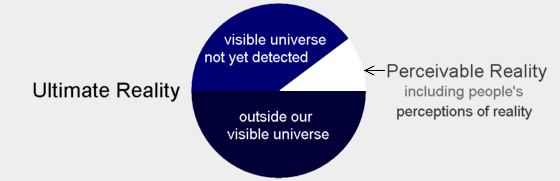
This reality helps people appreciate the difficulty of understanding reality, which includes three distinct
levels of reality, Ultimate Reality, Perceivable Reality, and people's perceptions of reality. The Perceivable
Reality view helps realize that many aspects of Ultimate Reality cannot now be sensed because they are too small
or too distant to detect or there is otherwise no evidence about them. For example, we lack crucial evidence
about conditions on Earth in the distant past showing how life came into existence and changed over time.
Consequently, the incomplete available evidence can be interpreted in many ways, as you know.
This website also pertains to the illusions people have that are inconsistent with perceivable reality. We are
all familiar with many illusions that harmed people in various ways. Human sacrifices to gods, and wars due to
illusions are examples. History shows that illusions can slow human progress, and current evidence indicates
that atomic weapons, or other dangerous technologies in the hands of people with dangerous illusions could
eventually cause the end of humanity. Perceivable Reality is a method for trying to distinguish between
unrealistic illusions and realistic perceptions of reality. If this method were widely understood and provided
to children eager to learn about their universe, it would help bring people together and improve the outlook
for humanity because history shows that ignorance of our environments and ourselves generally makes life less
understandable and more difficult.
Quantum Medium View (a.k.a. qm view)
The qm view section of this website, including the linked qmview.net website,
shows that science is not immune from illusions.
It shows that some very important parts of orthodox physics theory are probably wrong. It shows that
the generally accepted "law" of constant light speed, c, is very likely an illusion. Relativity theory is
based on this law. This is why relativity theory has strange aspects, such as having to combine units of
distance and units of time in our universe into the artificial concept of spacetime.
This section shows in detail that people are wrong who believe that relativity theory must be correct because
it agrees with the extensive body of related experimental evidence. It shows that agreement with experimental
evidence only means that a theory may be a correct representation of nature. This section shows that the
qm view is probably a much more realistic representation of nature because, in addition to agreeing with
the experimental evidence, the qm view explains logical physical causes for a wide range of phenomena that
relativity theory cannot explain, and it does not have illogical consequences such as relativity's consequence
of being able to travel back in time and change the course of history and even prevent our birth. It shows that
modern physics theory probably contains other illusions, constant light speed, c, being the most obvious.
Philosophy of Science
This leads to the philosophy of science section of this website which pertains to how science contributes to
our understanding of nature, a matter of great importance to everyone because our quality of life depends on
our understanding of nature. It pertains to a controversial academic matter concerning the meaning of scientific
theories and the criteria for judging them. Physicists tend to regard theories that are completely consistent
with all experimental evidence and other observed phenomena as "proven" and the theories can become "laws" that
are believed to be good representations of nature. But history shows that proven theories can result in
fundamentally wrong conclusions about the causes of the physical evidence. It shows that evidence can be
misleading and cause great misunderstandings of nature. Therefore, in addition to consistency with physical
evidence, good theories need to have other qualities discussed in this section.
As physics theory evolved during the twentieth century, the theories appear to have been shaped more by
experimental evidence and less by reason. This is consistent with the idea that science should be based on
verifiable evidence to avoid theories becoming unrealistic speculations. Theories with mathematics that
accurately reflected the experimental evidence were considered good theories, and the theories were believed
to be good representations of reality. This was arguably an effective way to advance physics theory.
It led to relativity theory and quantum mechanics and important technological advances based on these theories.
It also led to an overconfidence that the theories are correct.
The Philosophy of Science page of this website shows that mathematical models that accurately agree with
the experimental evidence and that can accurately predict phenomena may be describing artificial, mathematical
realities that are nothing like the physical reality of our universe. It has happened before, as you know.
As you can see, the various sections of this website have a bearing on one another.
Interacting Systems
This is another section that pertains to how nature works and how our system of mathematics can be used to
understand nature. It helps appreciate the complexity that can occur when simple systems interact.
Thinking and Beliefs
This section also contains information that is not widely known but is believed to be sound and useful.
It pertains to our consciousness, motivations, and how we form beliefs. It is based on evidence we can
all observe.
Ideas and Principles
This section contains information that can be helpful in life. The ideas and principles are mostly from
other people, and are widely recognized as being useful for guiding our thinking.
Regarding ACCURACY in this website
Most of this website deals with subjects where clear communication with the reader is essential and
where statements must be consistent with verifiable evidence and sound reasoning. Care has been taken
to make this website and the qm view website clear, accurate, and sound.
If you find anything you think is not clear or correct, please let us know.
Why this website may have limited appeal
The website involves thinking that differs from the ways most people are accustomed to thinking.
Therefore, most will consider it irrelevant or wrong because it disagrees with views
they believe are correct. The perceivable reality view, which shows the great uncertainty of past
and present belief systems, will seem strange or wrong to those who have learned, and become certain
of, a popular view of reality. The qm view will seem wrong to many who have learned relativity
theory and have become certain it is correct. In fact the qm view has been rejected by some
reviewers simply because it disagrees with relativity theory, and no one at a journal or elsewhere
has provided any other reason or evidence to show that it is not sound and plausible. Part of this
problem is that the qm view is not easy to understand quickly (although it's easier than
relativity theory). If you can understand how it explains constant light speed, c, inertia,
gravity, Doppler energy shifts, and a range of other phenomena, we think you will conclude
that it probably correctly describes the natural causes of these phenomena. We would welcome
your comments or questions about this website.
| |