| |||||||||||||||||
| Detecting and Determining Earth's Motion Through the QM | |||||||||||||||||
|
The quantum medium view explains why the rates of clocks, the
lengths of measuring rods, and the masses of bodies depend on the velocities of the clocks,
rods, and bodies through the quantum medium. Given these effects of absolute motion through the
medium, one would think that the medium would be easy to detect. This is not the case. Trying
to devise methods for measuring our velocity through the medium makes one realize how difficult
this is and why many past attempts have been unsuccessful. In 1887 A. Michelson and E. Morley
performed their now-famous experiment to detect the ether. The null results of this experiment
appeared to be proof that light is not propagated through a medium. This web site explains why
the Michelson-Morley experiment, and many similar experiments since then, could not detect the
medium.
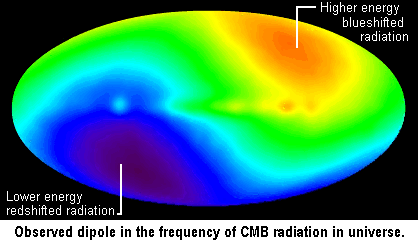
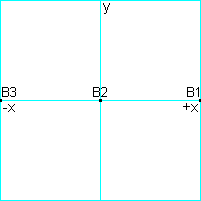
To check the absolute velocity indicated by the CMB radiation, other ways for determining the direction and magnitude of the solar system's motion through the medium should be explored. One possibility is based on detecting the small changes in the rates of our clocks as their absolute velocity changes due to Earth's rotation and revolution. If the absolute velocity of the solar system is in the direction of Leo and is .0012 times the speed of light (as indicated by the CMB radiation) then the variations in the rates of clocks on Earth due to Earth's rotation (for clocks near Earth's equator) and revolution are about .000,000,016 second/hour and .000,072 second/hour respectively. To detect these clock rate changes we could compare the clock rates with the rate of some physical process that is not affected by changes in Earth's absolute motion. One might think that millisecond pulsars could provide a time keeping means that is independent of Earth's rotation and revolution, but their apparent rates are affected by Earth's absolute motion, just as our clocks are affected. This becomes evident when one understands the quantum medium view. Perhaps there are processes on Earth not affected by Earth's absolute motion or affected more than our clocks by Earth's absolute motion. For example, the rate of radioactive decay of a particular radioactive substance might be independent of its absolute motion or it might be especially sensitive to its absolute motion. If this were the case, and its rate of radioactivity were measured with atomic clocks or other precise clocks, the rate of radioactivity would appear to have daily and yearly variations due to Earth's rotation and revolution. Daily and yearly variations in radioactivity have actually been observed by various groups, although they have not yet been connected to changes in Earth's absolute velocity. For example, Professor He Yujian of the Chinese Academy of Science has found that the beta decay of Co60 has a 24-hour period as opposed to a smooth decay over time. He attributes this to "a natural force field" that "leads to the appearance of circadian rhythms in both living and non-living systems ..." In Russia, studies of radioactive decay produced similar results showing that the decay rates have both daily and yearly variations. One Russian group states, "this phenomenon is shown not to be explained on the basis of traditional notion. A possible explanation is suggested basing on the hypothesis that there exists a new anisotropic interaction caused by the cosmological vectorial potential Ag, a new fundamental constant ..." [see arXiv:hep-ex/0105009 v1 7 May 2001. Experimental Investigations of Changes. in � -Decay rate of Co60 and Cs137. Yu.A. Baurov, A.A. Konradov, et al. www.citebase.org/cgi-bin/fulltext?format=application/pdf&identifier=oai:arXiv.org:hep-ex/0105009 ] The daily and yearly variations in radioactive decay rates are consistent with the quantum medium view. The variations are expected due to variations in our clocks and/or to actual variations in radioactive decay caused by changes in the energy-exchange rates in the decay processes (as Earth's velocity changes through the energy-transferring quantum medium). The daily and yearly decay rate variations support the quantum medium view, although it remains to be determined whether or not they can be used to determine the direction and magnitude of the solar system's absolute motion. Most in the physics community are unaware that the rates of atomic processes, and thus the rates of atomic clocks, are constantly changing by very small amounts due to Earth's rotation and revolution. The changing rates of radioactive decay, such as shown by the experimental results referred to above, should help create an awareness that the rates of atomic processes and clocks are constantly changing due to their constantly changing absolute velocities and energy-exchange rates. Another possibility for determining our absolute motion is based on detecting small changes in the measured value of the gravitational constant, G, which may occur due to changes in the direction of our absolute velocity as Earth rotates. This possibility needs to be investigated experimentally and is discussed further in the main document on this web site. The quantum vacuum and quantum medium The quantum vacuum (qv) of quantum mechanics theory is probably the same physical entity as the quantum medium. Theory and experimental evidence indicate that a quantum vacuum, seething with energy, pervades our universe and that quanta constantly materialize from and disappear into this qv. Orthodox theory also states that all inertial frames of reference are equivalent. If it is true that all inertial frames are equivalent, then how can two inertial frames that are moving relative to one another with high velocity (e.g. .9 c) have the same velocity relative to the qv? Does each inertial frame in the universe have its own quantum vacuum? Is it not much more plausible that there is only one qv and that different inertial frames have different velocities through the qv? This is consistent with the quantum medium view in which different inertial frames have different velocities through the qm. Does not the existence of the qv support the quantum medium view? Is it not likely that the qv, in which quanta constantly materialize and disappear, and the qm, through which quanta of energy are propagated, are the same aspect of nature? On the difficulty of measuring our velocity through the qm It is unfortunate that students are still taught that the Michelson-Morley experiment proved that light is not propagated through an ether or medium. It would help overcome this misconception if students were taught why the medium is consistent with the body of evidence that supports relativity theory and why it is so difficult to make direct measurements of our velocity through the medium. The following helps appreciate the difficulty. Within any inertial frame such as reference frame B shown in Figure 1 the speed of light will vary and will depend on the absolute velocity, vBa, of the frame moving through the qm. In the figures below, let vBa be in the +x direction. The speed of light moving through reference frame B in the direction of vBa will be slower than the speed of light in the opposite direction. Therefore, clocks in the reference frame that are virtually synchronized by sending and receiving light signals between the clocks will not be synchronized if the signals are assumed to travel at the same speed in both directions. Clock B1, which is located in the direction of vBa relative to clock B2, will be set retarded relative to B2. And clock B3, which is located in the opposite direction from B2, will be set advanced relative to B2. It is difficult to detect this asynchronization of B1, B2, and B3. For example, the asynchronization cannot be detected by using a portable clock which is first located next to B2 where it is synchronized with B2 and then carried to B1 or B3 and compared with B1 or B3. It is shown elsewhere on this web site why a portable clock synchronized with B2 will always arrive at B1 or B3 showing the same time as B1 or B3 except for a slight "relativistic slowing" which depends on the observed speed at which the portable clock is transported through reference frame B. One might think that the portable clock could be moved very slowly in B so the relativistic slowing is negligible. But the asynchronization between B1, B2, and B3 depends on vBa, and a detectable asynchronization depends on vBa being substantial. Therefore, the velocity of the portable clock through the qm will be substantial and it will significantly affect the rate of the portable clock. (See the "QM View 101" page for why a clock's rate depends on its velocity through the qm.)
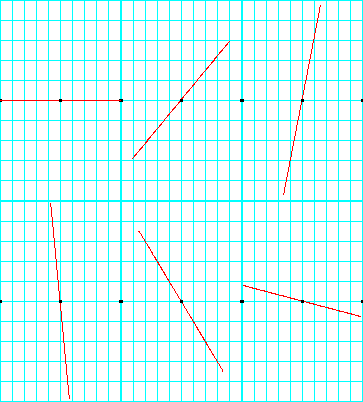
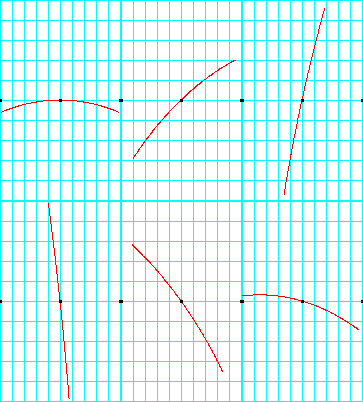
Our attempt to use a portable clock to show the asynchronization of clocks in frame B is thwarted by the inability to move clock C through frame B with a constant absolute velocity relative to B. To avoid this problem we could, in theory, use a long straight bar and rotate the bar so that its center remains at B2 while the ends revolve around B2 and periodically encounter B1 and B3 where the times on clock B1 and clock B3 are recorded as the bar passes. In this way we can time the trips of the ends of the bar from B1 to B3 and from B3 to B1. If the clock at B1 is set retarded relative to the clock at B3 the measured time for trips from B1 to B3 will be longer than for trips from B3 to B1. Will this not assure us that the asynchronization between the clocks at B1 and B3 will be detected? Unfortunately, not. In reference frame B the rotating bar will appear as shown in Figure 2 and the clocks at B1 and B3 will appear synchronized regardless of vBa. But only if vBa=0 will the rotating bar have a constant absolute length as shown in Fig. 2. If frame B has an absolute velocity of .8 times the speed of light through the qm, as shown in Figure 3, the actual absolute length of the bar will change as it rotates (for reasons explained on the "QM View 101" page). Figure 3 is for a bar having a period of rotation such that the velocity of the ends of the bar relative to frame B is low relative to the velocity of B through the qm. As the period of rotation decreases and the angular velocity increases, the shape of the rotating bar eventually will be curved as shown in Figure 4. But for observers in B, the rotating bar will continue to appear straight due to the asynchronization of the clocks at B1, B2, and B3. It was shown above why B3 is set advanced relative to B2 and that B1 is set retarded relative to B2. Due to this asynchronization, one end of the curved rotating bar will be at B3 when the clock at B3 reads a certain time, t, and later the other end of the bar will be at B1 when the clock at B1 reads the same time t -- which makes the bar appear straight to observers in B.
We have tried to show a few ways in which consequences of motion through the qm combine to prevent the detection of the motion. When one sees how the effects of the medium combine to obscure their measurement, it is more understandable why the medium has not been obvious. And when it is understood how much unexplained phenomena the medium explains in a logical way, there is good reason to be confident of its existence. Other Evidence of the Medium Although it may be difficult to find ways for detecting our velocity through the medium, considerable evidence indicates the medium's existence. For example, the medium easily explains the physical causes of the observed blueshift or redshift of the light from a source when an observer's velocity changes toward or away from the source. Orthodox physics theory does not have a plausible alternative explanation for this phenomenon. As Earth revolves around the sun, the asymmetry of the pattern of CMB radiation (i.e. the CMB dipole) changes. When Earth's velocity relative to the sun is in the general direction of Leo, the asymmetry is at its maximum, and six months later the asymmetry is at its minimum. In the quantum medium view the changes in the frequencies of the CMB radiation are caused for the same reasons that the sound of a railroad crossing bell changes for an observer on a train passing through the crossing. As the train and observer approach the crossing, the bell is observed to have a higher pitch and clang rate compared to the pitch and clang rate after the train passes through the crossing. Before passing the bell, the direction of the train's velocity through the sound-propagating medium is toward the sound source and this increases the velocity of the sound waves relative to the observer. After passing the bell, the direction of the train's velocity is away from the source and this decreases the velocity of the sound waves relative to the observer. This is the known cause of the observed shift in the frequency of the bell.

| |||||||||||||||||