A cornerstone of modern physics is the assumption and general belief that light
has the same constant speed, c, through all inertial reference frames (i.e. in vacuum in reference frames in which a
body at rest will remain at rest even when free to move in any direction). We will investigate some consequences of
this constant light speed assumption via an imaginary experiment that could actually be conducted on a smaller scale.
The experimental apparatus consists of a huge "light clock" and a
"reference frame" relative to which the light clock will move. The light clock is shown in Figure 1.
It is 300 million meters (m) long, the distance that light travels in 1 second (s). Located at each end
of the clock is an instrument comprised of a laser that can send a light pulse to the opposite end of the clock,
a detector that can detect light pulses received from the instrument at the opposite end, a counter that counts the
number of pulses received, and a display that shows the time based on the pulses received.
The light clock is started when the laser at R emits an initial red light pulse. The light
pulse, moving with a velocity of c=300,000,000 m/s, reaches B in 1 s and instrument B
detects the red light pulse, displays "1.00 s," and emits a blue light pulse in the opposite
direction. One second later, instrument R detects the return blue pulse and displays "2.00 s."

A mirror located 1,500,000 m from instrument R reflects part of each red light
pulse back to instrument R. When instrument R detects the reflected red pulse (.01 s after the pulse
is emitted) it emits another red light pulse and adds .01 s to the time display at R. Consequently,
every .01 s instrument B also detects a red light pulse, adds .01 s to its time display, and emits a
light pulse back toward the opposite end of the clock. Assuming that the speed of light is the same in both
directions, the time displays at R and B are synchronized, and an observer midway between R and B can observe this
synchronization.
The light clock is initially at rest relative to the reference frame shown in
figures 2a and 2b. Figure 2a is an end view of the reference frame (black) showing the light clock (red)
that will be moving sideways along the reference frame.
Figure 2b is a top view showing the light clock located at the zero distance end of the reference frame and
showing (via dotted red line) the location of the light clock after it has moved .75 light-seconds along the
reference frame. One light-second (ls) is the distance light travels in 1 s according to a reference
frame's clocks. It is 300,000,000 m in the reference frame. The reference frame has instruments like those on
the light clock that emit and detect laser light pulses and display the times when pulses are received.
These instruments are located at the ends of the green line at AA and BB.
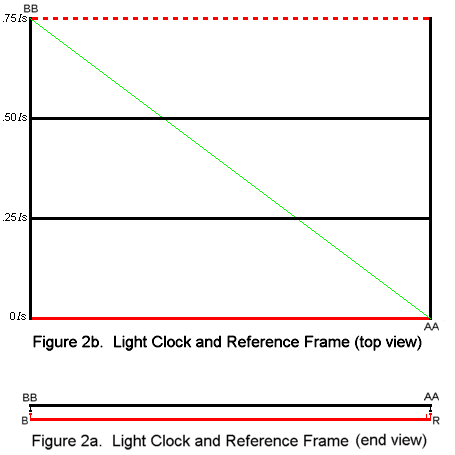
Just as the instruments aboard the light clock can detect the passage of time and
display this time, the instruments at AA and BB do the same. When an initial green light pulse is sent
from AA toward BB, the time display at AA reads 0 s and it advances .01 s every time a partially
reflected green light pulse is received back from a mirror (not shown) 1,500,000 m away. And the instrument
at BB is synchronized with AA and displays 1.25 s when the initial light pulse arrives from AA because the
distance from AA to BB is 1.25 ls (i.e. the square root of the sum of .75 squared and 1 squared). If the
instruments at R on the light clock and at AA on the reference frame are started simultaneously, all observers
aboard the light clock and the reference frame will agree that the time displays at R, B, AA, and BB are
synchronized. But if the light clock is made to move relative to the reference frame, this results in strange
and conflicting observations due to the observer's belief that the speed of light is constant in all inertial frames.
We are now ready to conduct this experiment which requires moving the light clock
far in the negative distance direction from its resting position shown in Figure 2b and then accelerating
the clock back toward the reference frame until it has a velocity of .6 c. As the moving clock passes the
0 ls location on the reference frame with its observed .6 c velocity relative to the reference frame,
the laser at R on the light clock and the laser at AA on the reference frame begin emitting light pulses every
.01 s toward B and BB respectively. The light clock arrives at the .75 ls location
(i.e. B arrives at BB) just as the initial red light pulse arrives at B and the initial green light pulse
arrives at BB. Strangely, instrument B displays "1.00 s" and instrument BB displays "1.25 s." This
disagreement of the clocks is predicted by relativity theory and the quantum medium view and confirmed by experiments.
This clock disagreement is just one of the perplexing observations and disagreements
between the observers aboard the light clock and the observers aboard the reference frame. For example, observers
aboard the light clock observe that the .75 ls distance shown on the reference frame is only .6 ls (the
distance the light clock moved in 1 s with a velocity of .6 c relative to the reference frame). They
observe that the reference frame has contracted in the direction of relative velocity.
It is also observed aboard the light clock that the times displayed at AA and BB on the reference frame are not
synchronized and that the rate of time on the reference frame is slower than the rate of time on the light clock.
Also, on the light clock it is observed that green light pulses emitted at AA somehow move from AA to BB in 1 s
whereas they took 1.25 s when the light clock was at rest relative to the reference frame. The theory of
relativity attributes all these disagreements and perplexing observations to the relative motion between the light
clock and reference frame. The theory has obscured the fact that they are all consequences of a quantum medium and
the constant speed of light assumption made by all the observers.
We will now see that all the observations made during the light clock experiment are
logical consequences of a quantum medium through which light is propagated at a constant absolute speed, ca. This
speed is 300,000,000 absolute meters per absolute second, where absolute meters (ma) and absolute
seconds (sa) are determined by distance scales and clocks at rest in the quantum medium. To make this
discussion as simple as possible, we will have the reference frame at rest in the quantum medium so that its
distance scale and clocks show absolute distances and absolute times. When the light clock was at rest relative
to the reference frame, its time displays at R and B also registered absolute seconds. But when the light clock
was moving with velocity .6 c relative to the reference frame, time slowed aboard the light clock. The light
pulses emitted at R took 1.25 sa to travel to B because their path through the medium was along the green
line traveled by the green light pulses moving from AA to BB. They had to travel 1.25 ls, not the
1.00 ls distance from R to B. Therefore, their velocity relative to the light clock was only
.8 ca, which slowed the light clock's time displays to .8 times their rate when at rest relative to the
quantum medium. This is explained in detail elsewhere on this website.
It is fascinating physics that shows why all processes aboard the light clock
are slowed (just as the time displays at R and B are slowed) and how other physical characteristics of a physical
system change when its velocity through the medium changes. This physics will open a new understanding of
nature when it is eventually widely recognized that light is propagated through a medium and does not have a
constant velocity through all inertial systems as is now generally believed and taught.
It will be seen that the measured speed of light in all inertial systems moving through the medium is always the
same due to the systems' distorted units of time and distance, along with the asynchronization of their clocks and
the observers' lack of awareness of these physical changes. This creates the illusion that
the speed of light, c, is isotropic and the same in all inertial systems.
Most in the physics community are happy with the way relativity theory works because
they don't realize there is a more plausible alternative. It works fine to say that the law of the
constancy of the speed of light, c, has been proven by experiments and to assume that the rates of our clocks and
the lengths and the masses of bodies do not change when the velocities of the clocks and bodies change (e.g. as
Earth rotates and revolves around the sun). Nature is simpler under these illusions. But the illusions come with a
steep price of having to abandon absolute standards of time, distance, and mass, and having no plausible physical
causes for the observed constant speed of light and relativistic phenomena. Given the choice, most scientists would
prefer that scientific theories explain as plausibly as possible the phenomena observed in nature. This website and
the quantum medium view booklet provided via the home page show that the logical consequences of the medium explain
the observed constant speed of light, the virtual symmetry of observations in reference frames moving
relative to one another, relativistic phenomena, and other important phenomena for which plausible physical causes
have not been apparent.
|

